Quick decoder 🗣️ cap = lie · no cap = no lie · fr = for real · ngl = not gonna lie · lowkey = subtly · highkey = very much · cooked = done for · brainrot = too much internet · delulu = delusional · hits different = affects you more deeply · unhinged = wild behavior
the water is at our chest and nobody’s okay
Ngl, I thought I was the only one spiraling.
Every morning: wake up, check phone, see a new AI model drop, a new framework, a new “this changes everything” tweet. Feel instant dread. Try to catch up. Fail. Feel behind. Repeat.
Then this one video popped up on my feed and it hit me. It’s not just me.
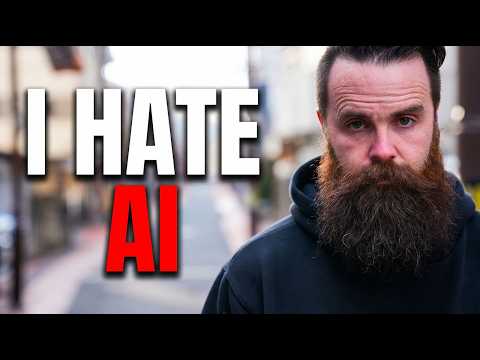
NetworkChuck, the guy with 5 million subscribers who teaches Linux and networking to millions, went on camera and said he almost quit YouTube because AI was stressing him out that bad. He literally flew to Japan on a sabbatical and the AI anxiety followed him there. Talking to AI while shopping. Voice-dictating while exploring caves. Doomscrolling his X feed while eating soba.
And honestly? I felt that in my soul. That constant pull of “if I stop for even a day, I’ll be irrelevant.” The inability to just exist without thinking about what new tool dropped while you were sleeping. It’s like being addicted to a slot machine that occasionally pays out in existential dread.
I’ve personally caught myself at 2am, eyes glazed over, reading about some new AI framework I’ll never use, feeling guilty about the three others I haven’t finished learning yet. That’s not productivity. That’s brainrot with a tech veneer.
the numbers are lowkey terrifying
Let’s not pretend this is just vibes. The data backs up the collective meltdown:
A UC Berkeley study found that 62% of AI workers report burnout, anxiety, and decision paralysis by month six. Not year six. Month six.
Amazon alone axed 16,000 jobs. Salesforce went from 9,000 to 5,000. The first rung on the career ladder? It’s lowkey disappearing.
And Anthropic’s CEO said 50% of entry-level white-collar jobs could be eliminated in one to five years. Industry insiders think he’s being conservative. As someone who’s still early in their career, reading that felt like getting punched in the stomach by a LinkedIn post.
the article that broke everyone’s brain
Then Matt Schumer’s article dropped. CEO of some AI company. 80 million views. And it absolutely cooked everyone’s mental health.
He said:
“I am no longer needed for the actual technical work of my job.”
And:
“If your job happens on a screen, then AI is coming for significant parts of it. The timeline isn’t someday. It’s already started.”
He compared the moment to realizing the water has been rising around you and is now at your chest. Not a sudden flood. A slow, steady rise that you only notice when it’s almost too late.
And the scariest part? Everyone agreed. It wasn’t just some hot take that got ratio’d. People were retweeting it going “send this to your family. warn them.” That’s not normal internet behavior. That’s collective panic.
but wait, is it actually true?
Here’s where it gets nuanced (I know, nuance on the internet, revolutionary):
- Schumer literally wrote the article with AI. The guy warning about AI used AI to write the warning. Let that marinate.
- He fed it articles he already agreed with, then had AI produce a polished version of his existing beliefs. That’s not analysis, that’s an echo chamber with extra steps.
- He started walking things back the second CNBC interviewed him.
- Gary Marcus (NYU professor) called it “weaponized hype”, pointing out there’s no data supporting flawless AI coding and hallucinations are still rampant.
Personally, I think the truth is somewhere in the messy middle. The article resonated because it described a fear we all already had, not because it presented groundbreaking evidence. Fear is a great algorithm hack. And scared people share things. That’s just how the internet works.
But here’s what’s NOT speculative: the anxiety is real right now. Whether AI takes our jobs in two years or ten years, the burnout and the feeling of being perpetually behind? That’s happening today. And that deserves attention regardless of whether the doom predictions pan out.
the love-hate relationship that’s breaking our brains
This is the part that genuinely makes me feel insane. Because it’s not just fear. It’s not just excitement. It’s both, simultaneously, at maximum volume.
Here’s the thing nobody warned us about: the very trait that made us fall in love with tech, that curiosity, that genuine love of tinkering and learning? It’s become our worst enemy in the AI era. It’s like a TikTok feed of new tech stuff to try. Every scroll is a new dopamine hit AND a new anxiety trigger.
I genuinely love exploring new AI tools. I get giddy when something works in a way I didn’t expect. And then ten minutes later I’m stressed because I realize there are fifteen more tools I haven’t even looked at yet. The excitement and the anxiety are literally the same emotion wearing different hats.
The Paradox Nobody’s Talking About
We’re the most excited generation of technologists who have ever lived and simultaneously the most anxious. We have God-tier tools at our fingertips and absolutely zero emotional infrastructure to handle what that means for our identity, our careers, and our self-worth.
The dopamine and the dread are coming from the same source. That’s not a normal thing to process.
openClaw, or: how i learned to stop worrying and no actually i didn’t stop worrying
OpenClaw dropped and it was genuinely transformative. Talk to your AI through WhatsApp, Telegram, Discord, Slack. Treat them like employees. Build entire IT departments. It’s wild.
And the response?
Even people whose literal job is to cover this stuff are freezing up. When the creator of a massive tech YouTube channel admits he couldn’t bring himself to make a video on OpenClaw because he was just exhausted, that says something about the pace we’re all trying to keep up with.
And I relate to that so hard. I’ll open my laptop with the intention of building something cool, and instead I spend two hours reading about what other people built, feeling progressively worse about my own progress. The tool isn’t the problem. The infinite scroll of everyone else’s highlight reel is. If even the pros are burning out at this pace, maybe the pace itself is the actual problem, not our inability to keep up.
okay so are we actually cooked? (no.)
Here’s where I refuse to leave you in the doom spiral. Because yeah, the stats are scary. The pace is insane. The burnout is real. But there’s another side to this.
the rebuttals that matter
A Fortune article pointed out: coding has compilers and unit tests to verify output. Law, medicine, finance? Way harder to automate because of subjective quality. Coding is actually one of the easier fields for AI to assist and even here, it’s struggling with the hard stuff.
Historical pattern? Every previous tech revolution overestimated the speed of transformation. Every. Single. One.
Here’s the kicker: 95% of organizations see no measurable ROI from AI. Ninety-five percent! The Yale Budget Lab said AI labor displacement “remains largely speculative.” Workers in AI-exposed jobs have stayed flat since ChatGPT launched.
Organizational friction is real. Someone has to sign off, retrain staff, change compliance, navigate liability. That takes years, not months.
your skills still matter (no, fr, they do)
Here’s a thought experiment: imagine a world where literally everyone has access to the exact same AI tools. Same models, same capabilities, same everything. What separates one person from another in that world?
What you actually know. Your fundamentals. Your Linux knowledge, your networking skills, your security instincts, your ability to reason about systems. That stuff doesn’t become less valuable when AI enters the picture. It becomes more valuable because it’s what lets you actually steer the AI instead of blindly accepting whatever it spits out.
I’ve noticed this firsthand. When I use AI for something I understand well, the output is 10x better because I can guide it, catch its mistakes, and know when it’s hallucinating. When I use it for something I don’t understand? I’m just vibes-checking the output and praying. One of those approaches ships working code. The other ships bugs with confidence.
the camera didn’t kill painting
I love this quote from Vishal Misra (Columbia professor):
“When the camera was invented, portrait painters had every reason to panic. The camera didn’t kill painting. It liberated it.”
And Eric Markowitz said: “We are not our tools. We never have been.”
That might be the most important sentence in this entire post. Read it again. Let it sit.
We are not our tools. Our identity isn’t “the person who writes code” or “the person who configures networks.” It’s the curiosity. The tenacity. The 2am debugging sessions fueled by spite and Monster Energy. The genuine joy of making something work.
AI can write code. AI can’t feel the absolute euphoria of fixing a bug that’s haunted you for three days. AI can’t have the “wait… WAIT… IT WORKS” moment. That’s ours. That’s human. That’s not going anywhere.
nobody has this figured out and that’s lowkey freeing
The most relatable thing I’ve heard about AI in 2026 wasn’t from some CEO’s keynote or a LinkedIn thread. It was a tech creator with millions of followers admitting on camera that he doesn’t have it figured out either. No pretending. No guru energy. Just honesty.
And I think that’s where we all need to get to. The era of “I’m the expert, follow my 10-step framework” is over because the landscape shifts faster than anyone can map it. Nobody has the complete picture. Not the CEOs, not the researchers, not the influencers, and definitely not me.
But here’s why that’s actually freeing: if nobody has it figured out, you’re not behind. You can’t be late to a destination that doesn’t exist yet. We’re all just walking in the same fog, and the honest people are the ones admitting they can’t see clearly either.
Permission Slip
You hereby have permission to:
- Not know what you’re doing with AI (nobody does)
- Feel overwhelmed (62% of AI workers do by month six)
- Hate AI sometimes (it’s a textbook love-hate situation)
- Not try every new tool (the FOMO is manufactured)
- Take a break (your brain needs WiFi-off time too)
- Be excited AND anxious (both emotions are valid simultaneously)
- Not have a plan (the landscape changes weekly anyway)
Signed: literally everyone in tech rn
so what do we actually DO?
Okay real talk. Enough doom. Enough analysis paralysis. Here’s what I’m personally doing about all this, and what I think actually works:
🧠 Learn the Fundamentals HARDER
When everyone has AI, your edge is what you know without it. Linux, networking, security, system design, these become MORE valuable, not less. You’re not learning against AI. You’re building the foundation that makes your AI usage 10x better than everyone else’s.
🛑 Set Actual Boundaries
Uninstall the AI news apps. Mute the hype accounts. Pick ONE tool and learn it properly instead of surface-skimming twelve. The anxiety comes from trying to drink from a firehose. Use a cup.
🤝 Learn Together, Not Alone
The “I’m the expert, follow me” era is over. Nobody has this figured out. Find your community. Discord servers, study groups, that one friend who also stress-tweets about LLMs at midnight. We’re all in the same boat. Might as well row together.
🎯 Build Things That Matter To YOU
Not because Twitter said it’s the hot new stack. Not because some influencer said you’re cooked without it. Build because you’re curious. Build because it’s fun. That’s the whole reason we got into tech in the first place. Don’t let the hype machine steal that from you.
🌱 Relentless Optimism (Not Delulu, Optimism)
I stole this phrase and I’m not giving it back. Not toxic positivity. Not “everything’s fine” while the house burns. Just a stubborn refusal to believe we’re doomed. No matter what comes, we’re gonna figure it out. We always have. The tech industry has survived every “this changes everything” moment. We’ll survive this one too, and probably build something incredible in the process.
the vibes going forward
Let me be real for a second. No slang, no memes, just genuine human words.
This is a weird time to be in tech. The tools are more powerful than they’ve ever been. The anxiety is higher than it’s ever been. And the gap between “what AI can do” and “what we understand about its impact” is a canyon.
But here’s what I keep coming back to: the people who got into tech because they genuinely love it will be fine. Not because some magical force protects passionate people. But because that curiosity, that drive to understand how things work at a fundamental level, that’s exactly what makes humans irreplaceable in an AI world.
AI is a tool. An incredibly powerful, occasionally terrifying, frequently annoying tool. But it’s still a tool. And we are not our tools. We never have been.
So yeah. AI burnout is real. The anxiety is real. The fear is real. But so is the excitement. So is the opportunity. So is the community of people going through the exact same thing right now.
We’re not cooked. We’re just… mid-recipe. And that’s fine.
Stay curious. Stay human. Stay unhinged (affectionate).
Inspired by NetworkChuck’s video on AI burnout. Go watch it, it’s the most honest thing on tech YouTube right now. Stats sourced from: UC Berkeley AI Worker Study (2025), Yale Budget Lab AI Employment Report (2026), Fortune AI Rebuttal (2026), layoffs.fyi tracker (2026), Anthropic CEO interview (2025).